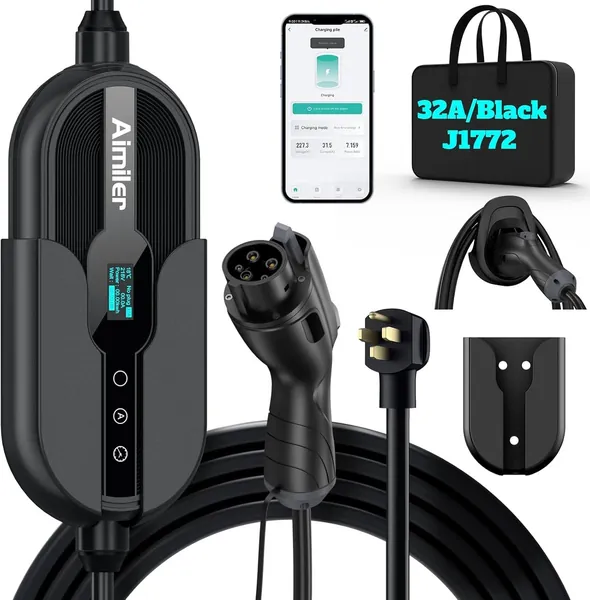
Outlet first, charger second.
Never use a household extension cord for EV charging, and never run a cord from a balcony, window, or patio door to the parking stall. If the receptacle is in the wrong place or the wrong type, the fix is a new receptacle installed by a licensed electrician. More:
extension-cord safety.
Plug-in hybrids (PHEVs) drive on battery for daily trips and switch to gas for longer ones. Because the battery is small, a full recharge overnight often fits on a 120 V outlet, which is far easier to get approved in a rental or condo than a new 240 V circuit. The catch: that outlet has to be suitable for continuous load, and many parking-stall outlets were installed for block heaters, not for charging.
Hours to refill: Level 1 vs Level 2 for a plug-in hybrid
Arithmetic only, for example battery sizes, before charging losses (real sessions take somewhat longer). Check your car’s manual for its usable battery and its onboard charger limit.
| Charging setup | Power (approx.) | 10 kWh to refill | 15 kWh to refill | 20 kWh to refill |
|---|
| Level 1, 12 A on 120 V | 1.4 kW | ~7 h | ~10.5 h | ~14 h |
| Level 1, 16 A on a dedicated 20 A circuit (if car and cord support it) | 1.9 kW | ~5 h | ~8 h | ~10.5 h |
| Level 2 limited by a 3.3 kW onboard charger | 3.3 kW | ~3 h | ~4.5 h | ~6 h |
| Level 2 limited by a 6.6 kW onboard charger | 6.6 kW | ~1.5 h | ~2.5 h | ~3 h |
Power = amps × volts. Times = energy ÷ power, rounded. Your car only takes what its onboard charger allows, no matter how big the Level 2 charger is.
Is Level 1 enough for your plug-in hybrid?
| Your situation | Usually enough? | Why |
|---|
| Park 10+ hours overnight, battery under ~15 kWh | Level 1 usually enough | A full refill fits in the time parked |
| Park overnight, larger battery or very cold mornings | Level 1 may fall short | Cold slows charging and some energy warms the battery |
| Short parking windows (shift work, shared stall) | Level 2 helps | More energy in fewer hours |
| Car onboard charger is 3.3 kW | A large Level 2 adds little | A 16–24 A setting already meets the car’s limit |
| Planning a fully electric car next | Ask for a 240 V outlet now | The same outlet serves your next car |
What to check before you plug in
- Ask your landlord or property manager whether the stall outlet is on its own circuit and whether EV charging is allowed on it.
- Never use a household extension cord to reach the stall. If the cord that came with the car does not reach, the fix is a closer receptacle installed by a licensed electrician.
- Ask who pays for the power and whether the outlet is timer-controlled (common on block-heater outlets, which may switch off part of the night).
- In Ontario, schedule charging overnight from the car if you pay your own electricity on a time-of-use or ultra-low overnight plan: see Ontario overnight rate.
- If Level 1 is not enough, ask for a 240 V receptacle: see landlord request letter or condo board approval.
Outlet and amp caveats
- A NEMA 14-50 receptacle is on a 50 A circuit at most, so plug-in chargers stop at 40 A continuous (Canadian Electrical Code Rule 86-302, about 80% of the breaker). A 6-50 works the same way for chargers with that plug.
- A plug-in charger set to 32 A needs a 40 A circuit; 24 A needs 30 A. Set the charger to match the breaker, never higher.
- Hardwired chargers above 40 A need a larger circuit sized by your electrician after a load calculation.
- New circuits need a licensed electrician and the permit your province requires (in Ontario, an ESA permit).
- Level 1 charging is a continuous load. A 15 A household outlet should carry no more than 12 A for EV charging; 16 A needs a dedicated 20 A circuit and a cord and car that support it.
Caveats
- Battery sizes and onboard charger limits vary by model and year; use your manual, not the example figures above.
- Times exclude charging losses and cold-weather effects.
- Nothing here is a statement of what your landlord or condo must allow.
FAQ
Can I charge a plug-in hybrid from a regular outlet in an apartment?
Often yes, if the outlet is suitable for continuous load, you have permission, and it is close enough to reach without an extension cord. At about 12 A on 120 V, many plug-in hybrids refill overnight.
Is Level 2 worth it for a plug-in hybrid?
Only if you park for short windows, have a larger battery, or plan to buy a fully electric car. Many plug-in hybrids accept only about 3.3 to 6.6 kW, so a large Level 2 charger adds little.
Can I use a block-heater outlet to charge a plug-in hybrid?
Ask first. Many block-heater outlets are shared or on timers that switch off for part of the night, and they were not installed for EV charging. Your landlord or a licensed electrician can confirm.
How long does a plug-in hybrid take to charge on Level 1?
Roughly the battery size divided by about 1.4 kW. A 10 kWh battery is about 7 hours and a 15 kWh battery about 10 to 11 hours, before losses.
Should I use an extension cord to reach my parking stall?
No. Household extension cords are not rated for EV charging. Ask for a receptacle closer to the stall, installed by a licensed electrician.