Owner vs renter — read this first.
BC’s clearer “request to install EV charging” framing is aimed at
strata lot owners (and the corporation process). It is
not a general apartment-tenant right to charge. Renters in BC strata or rental buildings typically still need
landlord / lessor permission. CleanBC MURB applications often require signed strata / co-op / landlord consent. See the
Renter Playbook.
Why BC matters for no-garage EVs
Among Canadian provinces, BC has one of the clearest published frameworks for strata corporations and individual owners requesting EV charging. Pair that process with CleanBC Go Electric multi-unit residential building (MURB) rebates administered by BC Hydro or FortisBC, depending on your utility.
Primary official hubs (confirm live):
Strata “right to charge” (high level)
Effective themes from December 2023 onward make it easier for individual owners to request EV charging, with a required process for both the owner and the strata council. Directional summary only — prefer live SPA / regulation text and the gov.bc.ca page.
-
Written owner request
Submit a complete written proposal for charging tied to your designated / exclusive-use stall where applicable. Include drawings, specs, and how costs will be handled. Keep copies of everything.
-
Council must follow the prescribed process
Strata corporations are expected to consider qualifying requests under the regulated path rather than an informal “maybe later.” Commentary often summarizes that corporations cannot unreasonably refuse — confirm exact statutory / regulation wording before you rely on that phrase.
-
Reasonable conditions still apply
Safety, certified equipment, insurance, cost allocation to the requesting owner, and electrical-capacity planning are typical legitimate conditions. “Right to charge” does not mean a free charger or a free stall.
-
Electrical Planning Report (EPR) context
Strata corporations with five or more lots generally must obtain an Electrical Planning Report on phased deadlines: commonly 31 Dec 2026 for Metro Vancouver / Fraser Valley / Capital Regional District areas, and 31 Dec 2028 elsewhere — confirm Regulations 5.7 / 5.8 and current gov guidance. EPRs should account for existing and anticipated EV load. An EV Ready plan is a separate rebate-oriented document and does not automatically replace a full EPR.
-
Licensed electrical work only
Use a qualified electrical contractor for new circuits, receptacles, or hardwired EVSE. No DIY panel work, no household extension cords, no balcony / window drops to the stall.
Outlet-first tip (still often useful).
Even inside the strata process, proposing a
dedicated continuous-load-rated NEMA 14-50R plus your own
plug-in weatherproof Canada-listed EVSE (CSA / cUL / ETL-C) can lower ownership friction versus jumping straight to a hardwired wallbox — subject to how your strata classifies the work. Details:
NEMA 14-50 & Outlet Guide.
CleanBC / BC Hydro MURB rebates (date-stamped)
Draft stamp: 2026-09-13. Figures below are directional from BC Hydro / Go Electric BC public pages and the EV Charger Rebate Program Guide themes (incl. July 15, 2026 program-guide updates). Funding is first-come, first-served and changes — re-check live before you apply or publish dollar claims.
| Item (MURB themes) |
Commonly cited max |
Notes |
| EV Ready plan |
Up to ~$3,000 / MURB |
~75% of eligible planning costs · one plan per building themes · |
| EV Ready infrastructure |
Up to ~$600 / stall |
~50% of eligible electrical work · building cap often ~$120,000 · |
| Charger (EV Ready path) |
Up to ~$1,400 / charger |
~50% of eligible costs · building charger cap often ~$14,000 · |
| Standalone MURB charger |
Up to ~$2,000 / charger |
Separate path; from ~15 Jul 2026 themes may require EV Ready plan, EPR, or approved opportunity assessment · |
| Combined EV Ready theoretical max |
Up to ~$137,000 / MURB |
Excludes municipal top-ups · Indigenous-owned MURB charger top-ups may be higher · |
Process flags (2026).
Pre-approval from BC Hydro or FortisBC is typically required before you start work or incur eligible costs. Individual MURB applicants may need signed strata / co-op / landlord consent. Standalone charger access rules tightened in mid-2026 program-guide updates — read the current PDF, not this page.
Owner checklist (short)
-
Confirm ownership + stall
Strata lot ownership, exclusive-use / assigned parking description, and whether electricity is common-property or individually metered.
-
Ask for bylaws + EPR / EV Ready status
Get current bylaws, any EV policy, and whether an Electrical Planning Report or EV Ready plan already exists.
-
Submit the written SPA-path request
Follow the gov.bc.ca / regulation process. Stay cooperative; cite the framework; keep a paper trail.
-
Get a contractor scope
Prefer dedicated 14-50R + plug-in listed EVSE, or the strata’s preferred listed configuration. Budget permits and inspections.
-
If seeking rebate: pre-approve first
Apply for pre-approval before buying gear or starting electrical work. Collect consent forms early.
Portable L2 after approval
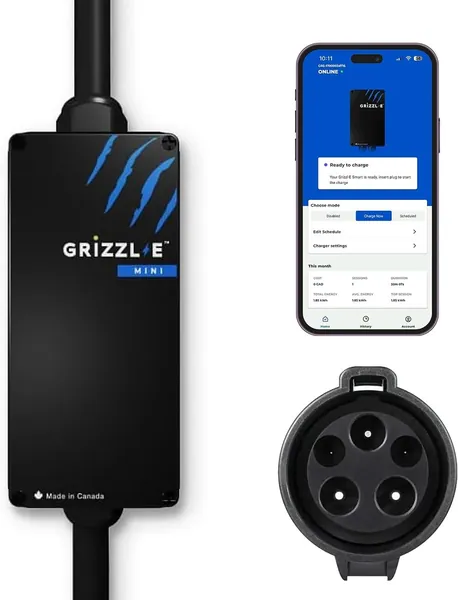
Once you have a proper dedicated receptacle (or approved install), a weatherproof Canada-listed portable Level 2 EVSE is often the practical personal charger — removable if you move or the strata requires it. Hardwired wallboxes are secondary when the building already specifies them. Approx CAD on Amazon.ca.
Compare: Grizzl-E vs AIMILER vs VEVOR → · Homepage outdoor picks →
Renters in BC strata buildings
Do not assume owner rights transfer to tenants. Ask the landlord / property manager in writing for a dedicated continuous-load-rated NEMA 14-50R and offer to pay the licensed electrician. Keep public / workplace charging as backup. Full renter framing: Renter Playbook: Charge Without a Garage.
Safety non-negotiables
- No balcony cords or window drops to reach the car
- No household extension cords for EV charging
- CSA, cUL, or ETL-C listed EVSE only
- Qualified electrician for new outlets / circuits
- Stop if plugs heat, smell, or trip breakers