Safety strip — memorize this.
NoGarageEV will never recommend balcony / window cord drops or household extension cords for EV charging. If a forum post or TikTok tells you otherwise, ignore it. Fire risk, insurance risk, and board / landlord rejection risk are all real.
Can I charge from my balcony?
No — not with a cord run from the balcony or window to the parking stall. That is unsafe, often against building rules, and a fast way to get banned from charging conversations. Charge only at a proper receptacle / EVSE at or adjacent to the vehicle, installed or approved for that purpose.
- Balcony outlets (if present) are usually for lights / cleaning — not EV continuous loads
- Cords across railings, down façades, or across drive aisles create trip, weather, and abrasion hazards
- Do the permission path instead: Renter Playbook or owner guides below
Can I use a household extension cord?
No. Everyday extension cords are not designed for EV continuous load. They can overheat, melt, and start fires. “Heavy duty” hardware-store cords aimed at tools are still the wrong answer for overnight EV charging.
Correct path: dedicated circuit + continuous-load-rated receptacle (often NEMA 14-50R) + Canada-listed EVSE. Details: NEMA 14-50 & Outlet Guide.
Is Level 1 enough for apartment life?
Sometimes. Level 1 on a permitted 120V outlet can cover short city commuting if you plug in every night. It struggles when you add highway trips, cold weather, or long outer-suburb commutes. Portable Level 2 on a proper 14-50 is the usual durable upgrade once permission exists. Comparison of weatherproof portables: Grizzl-E vs AIMILER vs VEVOR.
Do Canadian renters have a “right to charge”?
Usually no universal tenant right. Clearer statutory / regulatory paths typically favour condo / strata owners:
If you rent a condo unit from an owner, you often need both landlord cooperation and the owner’s corporation process. your lease and local rules.
How bad is cold-weather charging in Canadian apartments?
Cold reduces range and can slow charging while the pack warms. Rough winter range loss of ~25–35% is commonly cited for Canadian cities — confirm against your vehicle’s winter data. Practical tips:
- Prefer overnight Level 2 when you have it so preconditioning and cabin heat hurt less
- Precondition while plugged in before departure when the car supports it
- Budget more public / workplace top-ups in deep cold if you are stuck on Level 1
- Toronto / GTA winter + public backup notes: Toronto & GTA hub
Portable Level 2 or hardwired wallbox?
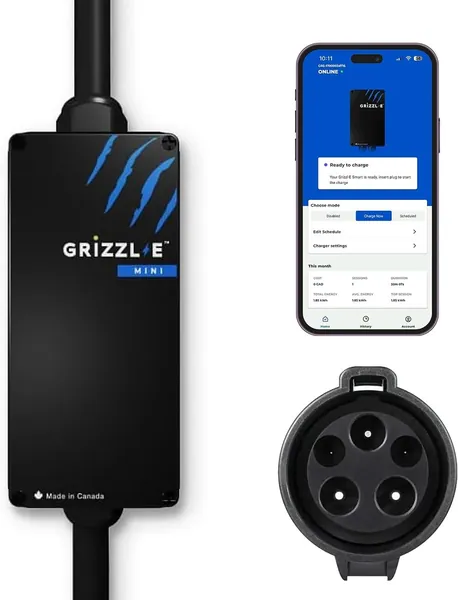
Portable primary for most apartment / condo no-garage drivers once a dedicated receptacle exists — easier ownership, removable if you move, clearer “I own the EVSE” story. Hardwired wallboxes are secondary when the building already specifies them, load-management gear requires it, or you own long-term and prefer fixed install. Top portable pick: Grizzl-E Mini Connect on Amazon.ca.
I have a Tesla / NACS port — will a J1772 portable work?
Yes, with a J1772 → NACS AC adapter (not the reverse, and not for DC fast charging). Buyer guide: J1772 to NACS adapter guide.
What if the building already has shared chargers?
Use them while you negotiate a dedicated stall solution — learn booking rules, fees, and etiquette. Shared stalls can queue; they are a bridge, not always a permanent substitute for a dedicated receptacle at your spot.
How much does a dedicated outlet cost?
It depends on run length, panel capacity, permits, and labour. Blog dollar figures are unreliable anecdotes. Get a licensed electrician quote (Ontario: Licensed Electrical Contractor / ESA themes — confirm). Offer to pay agreed costs when you ask the landlord or board — that honesty helps.
Are there rebates for apartment charging?
Sometimes — usually at the building / MURB level, not a simple renter coupon. BC CleanBC Go Electric MURB / EV Ready themes are the clearest national example right now; see BC Strata EV Charging with confirm-tagged rebate figures. Ontario / other provinces: check live utility and municipal programs before assuming money is available.
Can I install the outlet myself?
No. Hire a licensed electrician / Licensed Electrical Contractor. DIY panel and receptacle work is how people create fire hazards and insurance voids. Stop immediately if plugs heat, smell, or trip breakers.
Myth kill-list
| Myth |
Reality |
| “Balcony cord is fine if it’s outdoor-rated.” |
No. Still a cord drop to the car — don’t. |
| “Any 14-50 extension will do overnight.” |
No. No household / tool extension cords for EV charging. |
| “Renters have the same rights as condo owners.” |
Usually false in Canada — owner paths ≠ tenant paths. |
| “Any cheap Amazon EVSE is fine.” |
Prefer CSA / cUL / ETL-C listed gear; read live listings. |
| “Public charging means I don’t need home charging.” |
Possible for some drivers; many still want overnight L1/L2 for cost and convenience. |
| “Silence from the board means approved.” |
Do not assume — follow written process and confirm regulation text. |
Internal guide map
Primary portable CTA
After permission and a proper receptacle — not before, and never with an extension cord. Approx CAD on Amazon.ca.
Homepage outdoor weatherproof picks →