Outlet first, charger second.
Never use a household extension cord for EV charging, and never run a cord from a balcony, window, or patio door to the parking stall. If the receptacle is in the wrong place or the wrong type, the fix is a new receptacle installed by a licensed electrician. More:
extension-cord safety.
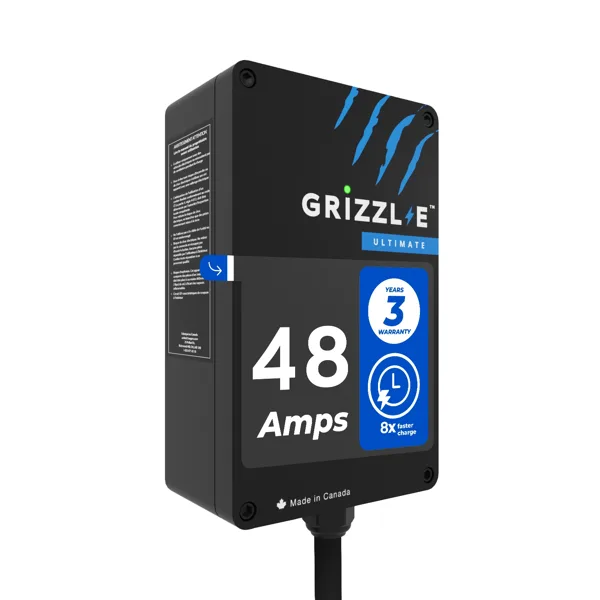
A 48 A charger sounds like an upgrade over 40 A, but for most people charging overnight at a condo or rental stall it changes very little. It also changes the install: 48 A can’t run through a NEMA 14-50 plug, so it means a hardwired charger on a bigger circuit. Here’s the arithmetic and when the extra amps are actually worth it.
Charger setting, circuit and range added per hour
| Charger setting | Breaker (about 80% rule) | How it connects | Power at 240 V | Range per hour* | Energy in 8 hours |
|---|
| 24 A | 30 A | Plug-in or hardwired | 5.8 kW | about 29 km | about 46 kWh |
| 32 A | 40 A | Plug-in or hardwired | 7.7 kW | about 38 km | about 61 kWh |
| 40 A | 50 A | NEMA 14-50 plug-in or hardwired | 9.6 kW | about 48 km | about 77 kWh |
| 48 A | 60 A | Hardwired only | 11.5 kW | about 58 km | about 92 kWh |
*Illustrative arithmetic using an example car that uses 20 kWh per 100 km, before charging losses. Cold weather, your car’s onboard charger and battery temperature all reduce real numbers.
Most daily commutes need well under 20 kWh. At 40 A, that’s about two hours on the charger. Even at 32 A, a normal overnight session covers a typical day of driving with room to spare.
Your car may not take 48 A anyway
The charger offers current; the car’s onboard charger decides how much it accepts. Many EVs accept somewhere between about 7 and 11.5 kW on Level 2. If your car tops out at 7.7 kW (32 A), a 40 A or 48 A charger won’t add any speed. Check the AC charging rate in your owner’s manual or the maker’s spec sheet before paying for a larger circuit.
When 48 A is worth it, and when 40 A is the better buy
| Situation | Better choice | Why |
|---|
| Renting, or a condo that prefers removable equipment | 40 A plug-in (or less) | A NEMA 14-50 plug-in moves with you; 48 A must be hardwired and stays behind |
| 100 A service or a tight condo electrical room | 32 A or 40 A, or load management | A 60 A circuit may not fit; see 100 A panel sizing |
| Car accepts 11 kW+ and you drive long distances most days | 48 A hardwired | Recovers about 10 more km per hour than 40 A |
| Two EVs sharing one charger on short overnight windows | 48 A hardwired, if the panel allows | Shorter sessions per car help when time is tight |
| Ontario ultra-low overnight rate | Usually 40 A is enough | The overnight window is long enough for most daily driving at 32–40 A: Ontario overnight rate |
Outlet and amp caveats
- A NEMA 14-50 receptacle is on a 50 A circuit at most, so plug-in chargers stop at 40 A continuous (Canadian Electrical Code Rule 86-302, about 80% of the breaker).
- A 48 A setting needs a hardwired charger on a 60 A circuit with wiring sized for it. Higher settings need a larger circuit still. Your electrician sizes the circuit after a load calculation.
- Many adjustable chargers can be set lower than their maximum. A charger rated for 48 A or more can still be set to 32 or 40 A to fit a smaller circuit.
- Never raise a charger’s setting above what the circuit is rated for, and never charge through a household extension cord or adapter chain.
- New circuits need a licensed electrician and the permit your province requires (in Ontario, an ESA permit).
Caveats
- Range figures are illustrative arithmetic, not a test. Winter cold can cut real-world charging speed and range noticeably.
- Product amp ratings come from current Amazon.ca listings; check the manual for the exact settings on your unit.
- Condo boards and landlords may limit the circuit size or require load management regardless of what the charger supports.
FAQ
Is a 48 A EV charger worth it over 40 A?
For most overnight home charging, no. 48 A adds about 10 km of range per hour over 40 A in our example, and only if your car accepts 11.5 kW. It also needs a hardwired install on a 60 A circuit.
Can a 48 A charger plug into a NEMA 14-50 outlet?
Not at 48 A. A NEMA 14-50 is on a 50 A circuit at most, so plug-in chargers are limited to 40 A continuous. A 48 A setting needs a hardwired charger on a 60 A circuit.
What breaker do I need for a 40 A EV charger?
Usually a 50 A breaker, following the Canadian Electrical Code continuous-load rule of about 80%. Your electrician confirms wire size and panel capacity.
How do I know how many amps my EV accepts?
Check the AC charging rate in your owner’s manual or the manufacturer’s spec sheet. A car rated at 7.7 kW gets nothing extra from a charger above 32 A.
Can I set a 48 A charger to 40 A or 32 A?
Many adjustable chargers can be set lower to match a smaller circuit. The installer sets it on hardwired units; check the manual for your model.